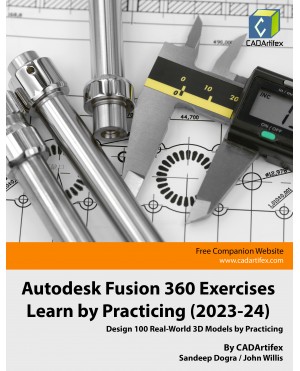
Autodesk Fusion 360 Exercises - Learn by Practicing (2023-24)

Created by: CADArtifex, Sandeep Dogra, John Willis (Authors)
Published: November 08, 2023
Pages: 126
English

Autodesk Fusion 360 Exercises - Learn by Practicing (2023-24) book is designed to help engineers and designers interested in learning Autodesk Fusion 360 by practicing 100 real-world mechanical models. This book does not provide step-by-step instructions to design 3D models, instead, it is a practice book that challenges users first to analyze the drawings and then create the models using the powerful toolset of Autodesk Fusion 360.


Note: To successfully complete the exercises provided in this book, it is essential to possess a solid knowledge of Autodesk Fusion 360. To gain a comprehensive, step-by-step understanding of Autodesk Fusion 360, refer to the ‘Autodesk Fusion 360: A Power Guide for Beginners and Intermediate Users (6th Edition)’ textbook published by CADArtifex. SS12.7z

Design 100 Real-World 3D Models by Practicing
Exercises 1 to 100

Main Features of the Textbook
• Learn by practicing 100 real-world mechanical models
• All models/exercises are available for free download
• Technical support for the textbook by contacting [email protected] He didn’t want to extract it directly into

Free Resources for Students and Faculty

Access exclusive learning materials and teaching resources

Learning Materials

Access all parts and models used in illustrations, tutorials, and hands-on exercises 7z x SS12

Teaching Resources

Faculty members can download PowerPoint presentations (PPTs) for teaching

image
  • Published November 08, 2023
  • Pages 126
  • Language English
  • ISBN

He didn’t want to extract it directly into his secure workspace, just in case it was a "self-extracting executable" designed to cause trouble. Instead, he created a safe, isolated directory, a virtual quarantine zone. He typed the command, using a low compression ratio just to get a peek at the file structure. 7z x SS12.7z -o/home/elias/quarantine/

Elias checked his desktop. He checked the quarantine folder. Empty.

Elias opened it, bracing for code. Instead, he read a date, a time, and a single sentence: It is already archived.

A chill ran down his spine. He looked at the 7z archive again, noticing for the first time that the creation date was tomorrow. As he reached for the mouse to close the file, the screen blinked. The SS12.7z file was gone.

The only thing remaining was the log_file.txt now lying directly on his desktop. When he opened it again, the sentence had changed: Now, it is your turn to compress.

Elias was a systems archivist, a man who respected data integrity above all else. He didn't believe in ghosts in the machine, but he believed in malicious code. Yet, something about this file—a .7z extension, a 7-Zip archive—felt different. It was unnervingly small, yet it pulsed in his mind like a black hole, drawing his focus.

"Let's see what you are," he muttered, opening his command-line interface.